POSITIVE SPACE STRATEGY FOR DESIGNING AN IRANIAN VERTICAL NEIGHBORHOOD (PROJECT)
Master’s Thesis, Azad University, Iran, 2015 Supervisor: Dr Khosro Sahaf
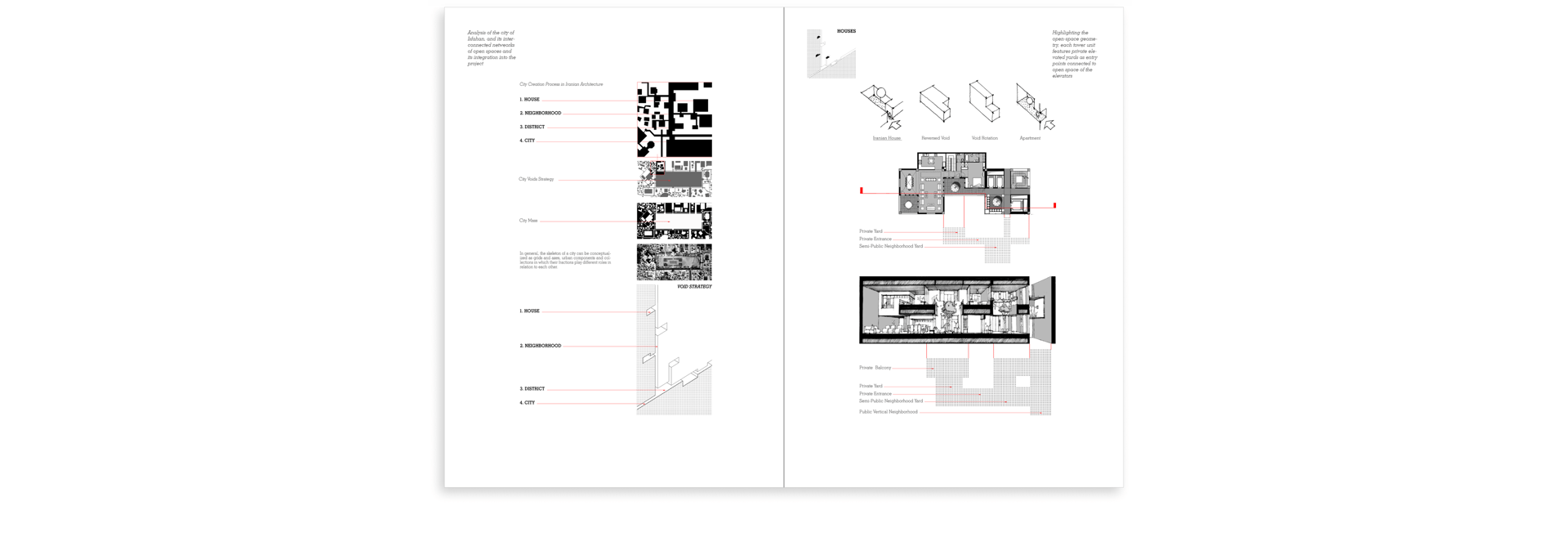
A strong skeleton defines the spatial and social organization of Iranian ancient cities, with a hierarchy of interconnected spaces ranging from private courtyards to expansive public squares. This structure, rooted in regionalism, begins with the “courtyard” house, which aggregates into “neighbor- hood” yards, scales up to “district” valleys or squares, and culminates in the “city” square. These integrated networks fostered social cohesion but were disrupted by modernization, particularly through the introduction of cars. This car-centric development, enforced by Western technologies and ideologies, undermined the culturally grounded urban fabric and replaced it with fragmented, standardized systems.
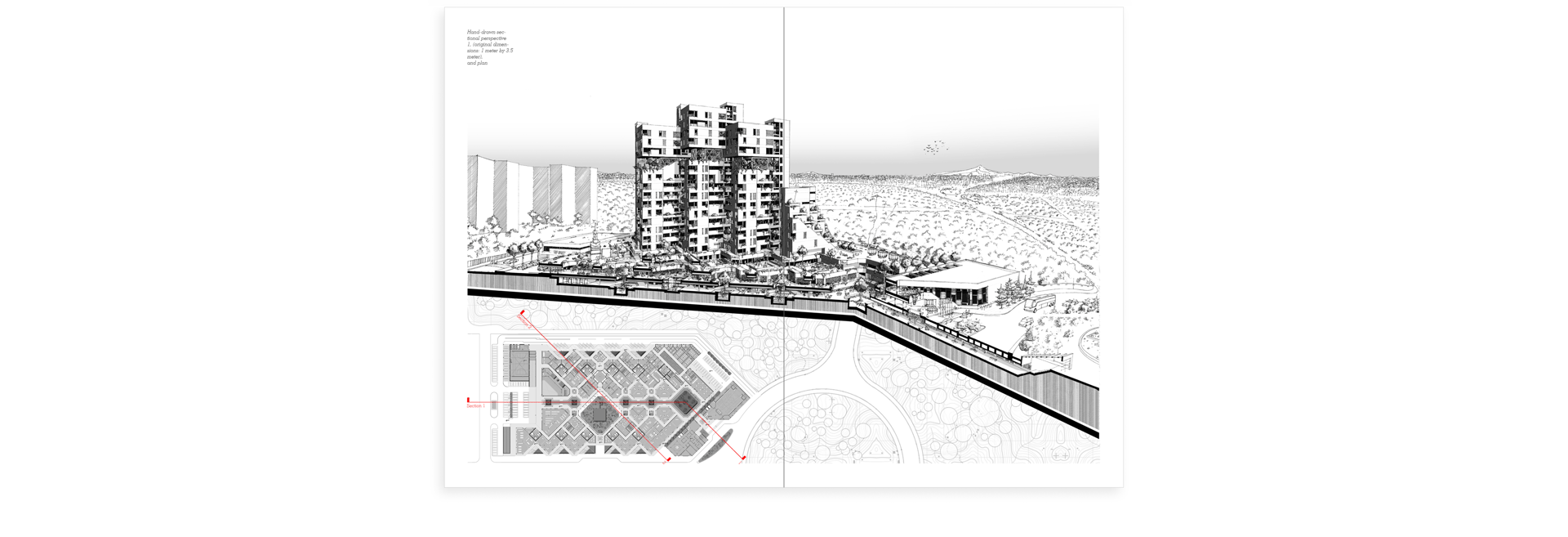
High-rise apartments, while often critiqued for their density and lack of community, offer opportunities to counteract this fragmentation. Reimagined without car-centric infrastructure and using elevators as soft machines, high-rises can become vertical extensions of the traditional urban skeleton. Elevators replace streets, connecting spaces seamlessly and fostering a new kind of community integration, transforming high-rises into refuges from car-dominated sprawl and reclaiming regional spatial logics in a contemporary form.
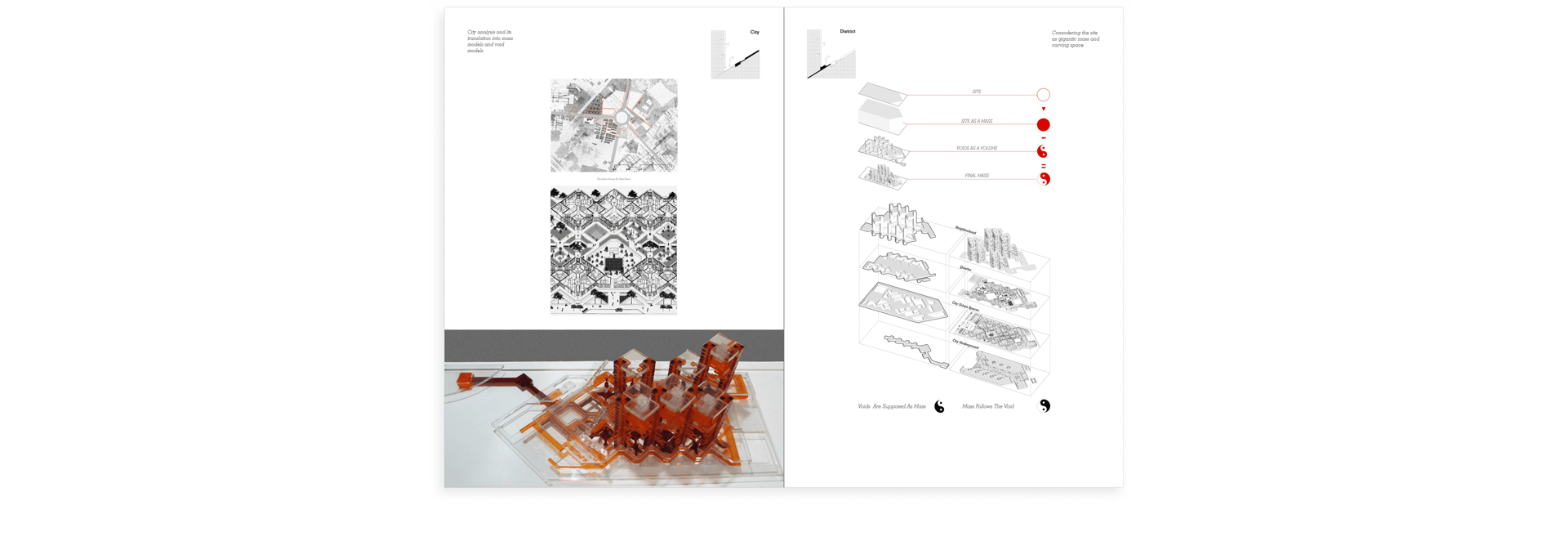
In my “Positive Space Strategy,” I create a vertical network of interconnected voids at the scales of “HOUSE,” “NEIGHBOR- HOOD,” “DISTRICT,” and “CITY.” Reversing this void structure reveals the mass, forming a “Vertical Neighborhood” where residents retain the essence of courtyard living houses with private yards, communal yards for children to play, and spaces for informal neighborly interactions all connected vertically. This design challenges the colonial legacy of car-centric urbanism, reclaiming regional identity while addressing modern challenges through a postcolonial and regionally inspired framework for urban living.